The Deductible Dilemma
Betting against yourself. Why raising your deductible is legal gambling.
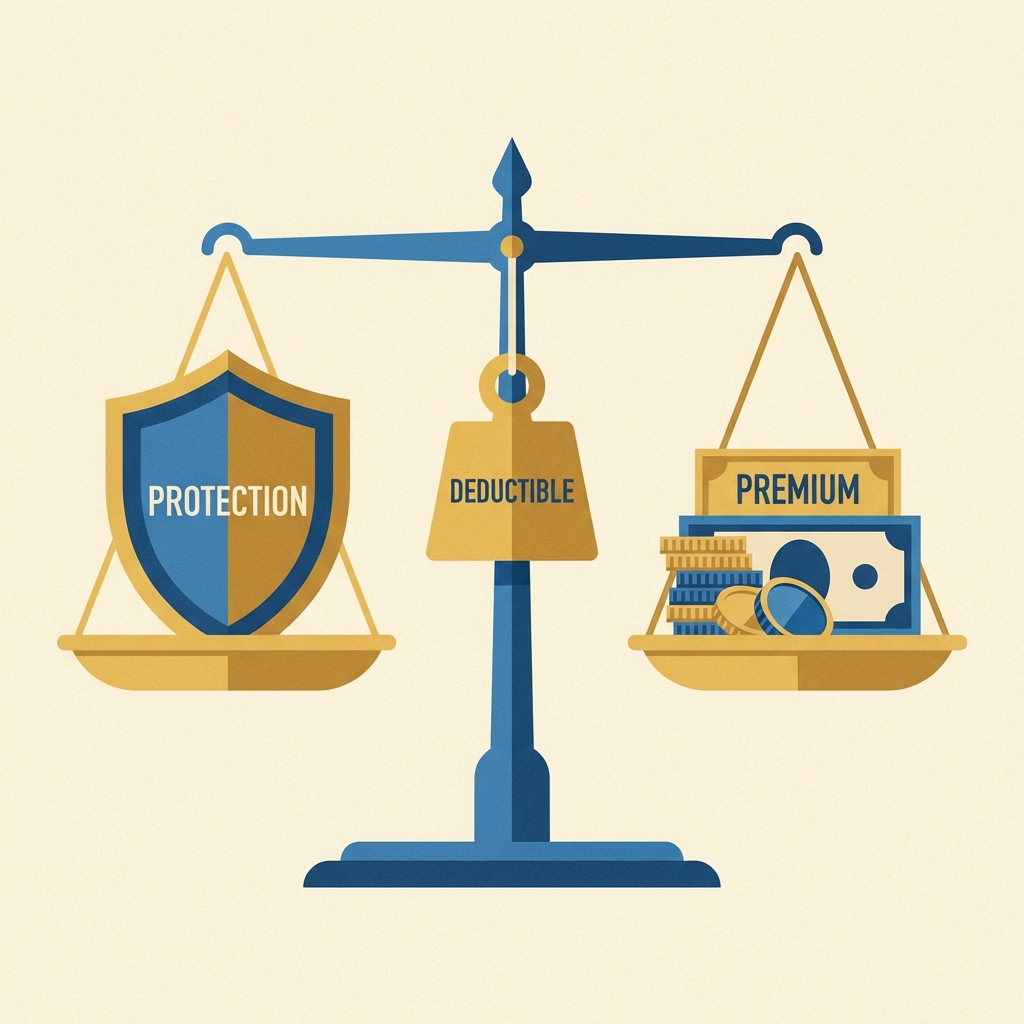
The easiest way to lower your car insurance bill instantly is to raise your deductible. But is it a trap?
When you buy a policy, you are asked to choose a number: $250, $500, $1000, or even $2000. This is the amount you agree to pay out of your own pocket before the insurance company pays a dime. It's a risk calculation: Does the monthly saving justify the potential lump-sum pain?
1. The Math of $500 vs. $1,000
Let's look at real numbers. Suppose your premium for full coverage is $150/month with a $500 deductible.
- Option A: Keep the $500 deductible. Yearly Cost = $1,800.
- Option B: Raise deductible to $1,000. Yearly Cost drops to $1,500 ($25/month savings).
The Break-Even Analysis: You save $300 a year. The difference in risk is $500
($1000 - $500).
It will take you less than 2 years (1.6 years) of savings to "pay for" that
extra risk. If you don't crash in the next 2 years, you are purely profitable.
2. The "Emergency Fund" Rule
The math says "Go High." But life says "Be Careful."
You should NEVER choose a $1,000 deductible if you do not have $1,000 sitting in your bank account right now. If you crash your car and can't pay the deductible, the body shop will not release your vehicle. You will be stuck paying for a rental car while your own car sits hostage. Only bet what you can afford to lose.
3. When Does the Deductible Apply?
Many people are confused about when they have to pay.
You Pay Your Deductible When:
- You hit a tree, a pole, or a fence (Collision).
- You hit another car and it is your fault (Collision).
- A hail storm destroys your hood (Comprehensive).
- Your car is stolen (Comprehensive).
You Do NOT Pay Your Deductible When:
- Someone else hits you (Their insurance pays 100%).
- You have a "Glass Waiver" and just need a chip repair.
4. The Vanishing Deductible
Some companies (like Nationwide and Liberty Mutual) offer a "Vanishing Deductible." For every year you drive accident-free, they lower your deductible by $100. eventually, it hits $0. This is a great perk, but check if the base policy is more expensive to begin with.
Conclusion
If you are a safe driver with an emergency fund, raise your deductible to $1,000. The long-term savings are almost always worth it. But if you live paycheck to paycheck, stick to $500. The peace of mind is worth the extra $20 a month.